
In 1922, at a laying contest in Geelong, Victoria, six hens laid 1,857 eggs in 365 days. That is 309.5 eggs apiece, and they did it without a light on a timer in the coop.
Those hens were Australorps. That contest made the breed, and a century later the number is still doing sales work. Open any hatchery catalog in February and the Australorp shows up as the world record layer, which is true, at about four dollars a chick, which is also true.
What the catalog leaves out is that the same breed name covers birds bred to lay 190 eggs a year and birds bred to lay 300. The chick costs the same either way.
Australorps are still a bird worth keeping. Just not for the reason the catalog gives you.
What is a Black Australorp chicken?
A Black Australorp is a heavy dual-purpose chicken developed in Australia out of imported Black Orpington stock and then bred hard for eggs. Black is the only variety recognized in the United States.
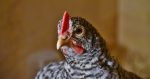
The American standard sets cocks at 8.5 pounds and hens at 6.5, with cockerels at 7.5 and pullets at 5.5. The plumage is black with a beetle-green sheen that only shows up in direct sun. The comb is a single red comb with no more than seven points, the eyes are dark brown, and the shanks are black shading to slate with the bottoms of the feet and toes pinkish white. The skin is white rather than yellow.
The eggs are tinted to light brown and average 26 to 27 ounces per dozen, which puts them at the top of the Large grade and sometimes into Extra Large.
That is the bird on paper. The bird in your run is a separate question, and it is the one this article is actually about.
Where the Black Australorp came from
Black Orpingtons from the yards of William Cook and Joseph Partington went to Australia between 1890 and 1900. In England those birds were being refined for meat. The Australians looked at the same chicken and saw a layer.
So they bred for eggs and nothing else. Outcrosses went in from Minorca, White Leghorn, and Langshan, with Rhode Island Red in the original imported stock and a report of Plymouth Rock somewhere in the mix. Five bloodlines did most of the work between 1900 and 1922: Graham, Burns, Christie, Bertelsmeier, and Drewitt. All five bred deliberately against broodiness, because a hen sitting on a clutch is a hen not laying, and the contests counted eggs.
Then came the records. Geelong in 1922-23. A hen at the Grafton contest laying 347 in 365 days. A Burns bloodline hen at 354. Finally 364 eggs in 365 days under official Australian trap-nest testing, which is a number nobody has beaten.
Orders came in from England, America, South Africa, Canada, and Mexico. The American Poultry Association added the breed to its Standard of Perfection in 1929.
And then the thing that happened to almost every good dual-purpose bird in America happened to this one. The Australorp got crossed with the White Leghorn into the AustraWhite, which took over Midwestern farms in the 1930s and 40s before falling to the proprietary inbred hybrids sold under names like Hy-Line and DeKalb. The breed did not lose on merit. It lost to a business model that could sell you a new bird every eighteen months.
How many eggs do Black Australorps lay?
A well-bred backyard Australorp lays 250 or more eggs a year, which is four to five a week averaged across a full year including a molt. At peak, in spring and early summer, five or six a week is normal. I have had hens hit six in a single week!
Most pullets start laying around five to six months. Some start at sixteen weeks and some make you wait until seven months, and feed, daylight, and hatch date all move that date around more than the breed does.
The eggs are light brown. Not chocolate like a Marans, not pink, just the ordinary brown you see in a carton at the store.
They do lay through winter better than most, and that reputation is earned rather than magic. Australorps are cold hardy and they keep eating in cold weather. But every chicken slows down as daylight shortens, and a hen needs roughly fourteen hours of light to keep cycling. If yours quit in December, nothing is wrong with them.
They are serious foragers
Turn an Australorp loose and it will spend the whole day working. They scratch, they hunt bugs, they follow you around the garden, and they turn kitchen scraps into eggs faster than you can generate the scraps.
This is not a small thing for a backyard flock, because forage displaces purchased feed. It also goes the other direction. The Livestock Conservancy notes that Australorps do fine in confinement as long as they get some range, and that kept strictly confined, they get fat. A fat hen is a hen that stops laying.
So the foraging is not a perk. For this breed it is closer to a requirement.
Docile, and what docility costs
Australorps are calm. My kids can pick one up without getting pecked or scratched, and even the roosters tend toward mellow, though every rooster is his own animal. They sit near the middle of a mixed flock’s pecking order, which is exactly where you want a bird: not getting bullied, not doing the bullying.
Here is the part the temperament sections usually skip. A calm bird is a bird that does not run.
Australorps are slow to react to hawks. The trait that makes them pleasant to handle is the same trait that makes them easy to catch, and if you free range without cover, you will lose birds. There is a barnyard theory that hawks avoid black chickens because they read as crows. It is folklore with nothing behind it, and it is not a predator plan.
Build the predator plan around cover. Shrubs, a run with a roof, a dog that stays out with them.
Are they actually dual purpose?
Yes, with an asterisk that has nothing to do with the bird and everything to do with what you are comparing it against.
An Australorp cockerel processed at 20 to 24 weeks gives you roughly four to five pounds dressed. That is a real meal and a real carcass, with a broad breast and enough dark meat to be worth the work. A Cornish Cross gets to a comparable weight in about eight weeks, which is why the Cornish Cross is what almost every American eats.
Spent hens are the other half of it. Production tails off after two or three years, and a stewing hen at that age makes better stock than any bird you can buy.
If you want a freezer full of chicken in two months, this is the wrong breed. If you want a flock that lays for years and puts meat on the table at the end of it, this is close to the best available.
Which Australorp did you actually buy?
Here are three numbers for the annual egg production of a Black Australorp hen, from three organizations that all know what they are talking about.
| Source | Hen weight | Eggs per year |
|---|---|---|
| Bund Deutscher Rassegeflügelzüchter, German breed standard | 2.0 to 2.5 kg (4.4 to 5.5 lb) | 190 |
| The Livestock Conservancy, US | 6.5 lb | 250+ |
| Australian trap-nest contests, 1922-24 | not recorded | 309.5 average, 364 record |
The German figure is not an error. The Bund Deutscher Rassegeflügelzüchter is the national association that writes the breed standards German exhibition breeders show to, and its published table for Black Australorps says 190 eggs at 55 grams, from a hen a full pound lighter than the American standard bird. That is what a century of breeding toward the show cage produces.
The Australian number came from birds selected for one thing, counted one at a time in a trap nest, in a competition where the whole point was the count.
Meanwhile McMurray Hatchery, which sells the chicks, advertises 281 to 365 eggs per year. Hoover’s describes the breed as selected for high egg production on a page with an order button on it.
Nobody here is lying. The record is real, the German standard is real, and the Livestock Conservancy number is an honest description of a good backyard bird. The problem is that a breed name is being sold as a specification, and it is not one. “Black Australorp” tells you what a bird looks like and what its great-grandparents were selected for. It does not tell you what this particular hen will do in your run, because that depends entirely on which breeding program she came out of and what that program was optimizing.
Quality in, quality out. It applies to genetics the same way it applies to feed.
What Black Australorps are bad at
Heat. This is the real one, and it gets four sentences in most breed guides. A black bird in full sun absorbs everything. Poultry sit in a thermoneutral zone between 60 and 75 degrees Fahrenheit, and as temperatures climb toward 85, birds cut feed intake and production to shed heat. In a 28-day controlled trial on commercial brown layers, not on Australorps, severe heat stress at 91 degrees and 66 percent humidity cut feed intake by 30 percent and the egg production rate by 11 percent against a thermoneutral group. The Livestock Conservancy’s own care note is that because of their color, Australorps need ample shade in warm weather. If you are in the humid Southeast, shade and cool water are not optional.
Broodiness, in both directions. The founding breeders bred it out. Backyard lines have drifted back toward it, and modern Australorps are good sitters and mothers. Whether that is a feature or a bug depends on whether you want chicks or eggs.
They are not a hybrid layer. A commercial brown hybrid will out-lay them in year one. The Australorp’s advantage is that she is still laying in year four.
Confinement. Covered above, and worth repeating because it is the most common way people get disappointing results from this breed.
How to buy a Black Australorp worth having
Skip the breed name. Ask about the parents.
- Ask the seller what the parent flock laid last year. Not what the breed lays, what those hens laid. A small breeder who tracks production will tell you a number. One who has never counted will tell you about the world record, and now you know something.
- Ask what the flock was selected for. Show quality and egg count pull in opposite directions, and there is no wrong answer, only an answer you need before you buy.
- Buy from someone within driving distance if you can. A local breeder’s birds have already proven they can lay in your climate, which for a black bird in a hot state is most of the question.
- Order early for spring. Chick demand runs hardest in March and April and the good lines sell out first.
- If the hatchery catalog is your only option, that is fine. Buy the chicks, count what your hens actually give you in year one, and let that number tell you whether to go back.
That last one is free, and it works on any breed you will ever buy. Count the eggs yourself. A production figure you collected in your own coop beats every number on every catalog page, because it is the only one measured on your feed, your daylight, and your weather.
Get some Australorps. They are good chickens, they are friendly, they lay well for years, and they will eat every bug in your garden.
Just find out what you bought before you decide what you got.