
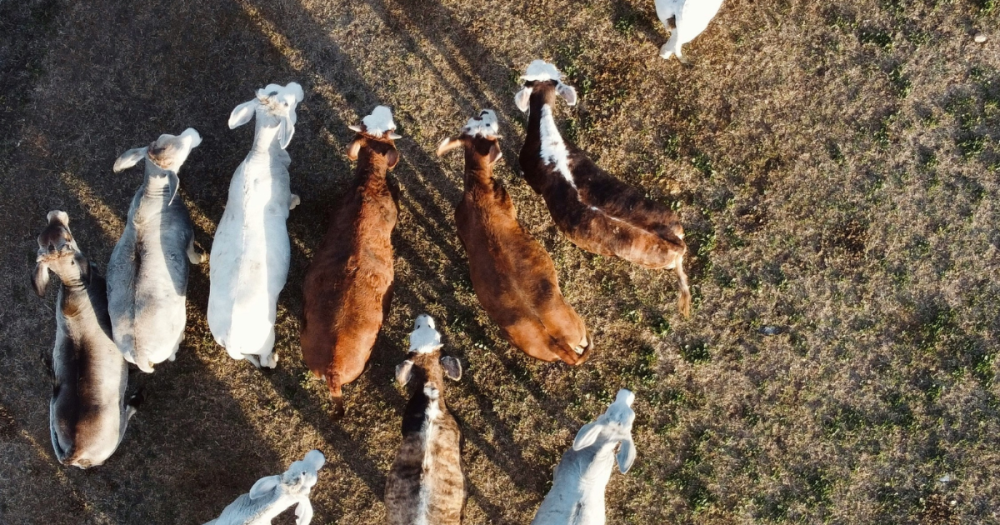
It’s a strange thing that cows have become a divisive topic.
“It’s not the cow, it’s the how.”
That’s the line Nicolette Hahn Niman is known for, a 33-year vegetarian and environmental lawyer who married a rancher and became one of beef’s most effective defenders. I steal it constantly on farm tours when somebody asks me why I’d defend an animal they’ve been told is cooking the planet.
Cows have a genuine superpower. Put them on the right ground, move them at the right speed, and they’ll improve almost any landscape on Earth.
And there isn’t one type of cow. There are hundreds, each one shaped by a specific place with specific problems. Here’s what they are and what each one is actually good at.
What are the types of cows?
Cattle sort into four working types, and every breed on this page belongs to one of them.
- Dairy. Bred to convert feed into milk volume and components. Holstein, Jersey, Guernsey, Ayrshire, Brown Swiss.
- Beef. Bred to convert feed into muscle, marbling, and growth rate. Angus, Hereford, Charolais, Brahman.
- Dual-purpose. Bred to do both adequately rather than either superbly. Simmental, Milking Shorthorn, Red Poll, Dexter.
- Miniature. Any of the above, scaled under about 48 inches at the hip.
Draft cattle used to be a fifth type, and in much of the world, they still are. In America, a tractor took that job.
Those are categories, not species. Underneath them sit the actual breeds, and there are a lot of them.
How many breeds of cows are there?
More than a thousand, and the reason there are that many is that cattle weren’t domesticated once. They were domesticated at least twice, on two continents, from two different wild populations.
The FAO’s global livestock registry tracks around 8,800 breeds across roughly 40 species, with cattle among the most diverse.
Taurine cattle, the humpless kind, came out of the Fertile Crescent from the European aurochs more than 10,000 years ago. About 1,500 years later, in the Indus Valley, a different aurochs population became the humped zebu, and researchers have proposed a third domestication in northeast Africa on top of that.
So when somebody tells you a cow is a cow, they’re off by a species. Your Angus and a Brahman are not the same animal wearing different coats. They’re two separate lineages that split from each other roughly a quarter of a million years ago and got domesticated by two different sets of people solving two different problems.
That’s the whole reason this list is long. A thousand breeds exist because a thousand places needed something different, and for most of human history the differences were life and death. A cow was meat, milk, leather, fuel, and the engine that pulled a plow, often all at once, in a household that had no backup if she failed.
Cattle are now raised on six continents. Almost every one of those breeds was somebody’s answer to a problem you and I have never had to solve.
How cows heal the land
Cows are ruminants, which means they run a fermentation vat that turns cellulose humans can’t touch into meat, milk, and fertility. Grass goes in. Soil comes out the back.
How much? Penn State Extension puts a dairy cow at defecating every 1.5 to 2 hours and excreting 100 or more pounds of manure a day. That’s a lactating dairy animal, so a dry beef cow runs lower, but the picture holds.
Now picture that spread across a pasture on hooves instead of scraped into a lagoon. Same animal, same manure, completely different outcome.
That’s the “how” Niman was talking about. Rotation, rest, and density decide whether a cow builds topsoil or destroys a creek. The cow doesn’t get a vote.
Types of beef cows
A good beef animal is judged on muscle, marbling, growth rate, feed efficiency, and whether it can live where you’re asking it to live. That last one is where breeds stop being interchangeable.
Angus. Originally from northeast Scotland, out of the native black hornless cattle of Aberdeen and Angus counties, and the benchmark for a reason. Angus marble early, finish on grass, calve easily, and are naturally polled, which saves you a job you’d rather not do. Ceva’s ruminant technical group puts mature bulls at 850 to 900 kilograms, gaining about 1.3 kg a day and dressing around 63 percent.
Red Angus is the same animal in a red coat, and that coat is worth real money in the Southeast, where a black hide absorbs heat a red one reflects. Everything you’ve heard about Angus beef is true. What’s happened to the hide is a different story.
Hereford. Red body, white face, and a mothering ability that made it the backbone of range cattle across three continents. Herefords are fertile, long-lived, and famously low-maintenance on rough pasture, which is a polite way of saying they’ll graze ground that would embarrass a fancier animal. Bulls mature around 900 kg and dress near 62 percent.
The Irish Hereford Society built its case on calving ease, and it’s the right case. If you want a cow that calves in a field without you standing there at 2 a.m. with a flashlight, this is the one. It’s also why Hereford shows up in so many crossbreeding programs. You’re buying temperament and fertility as much as beef.
Simmental. Swiss, dual-purpose, and enormous. Mature weights run above 1,150 kg with daily gains around 1.5 kg and dressing near 64 percent, and they’re used heavily in beef and dairy crossing worldwide, including on zebu breeds in the tropics.
The superpower is that you get two things at once. Heavier weaning calves, and enough milk in the cow to raise them. Sim-Angus is now one of the most common crosses in America for exactly that reason. The trade is obvious the first time you buy hay. That’s a lot of animal to keep through a winter, and a big cow on thin ground is a cow that comes up open.
Charolais. French, white, and built like a bank vault. Charolais are the muscle breed: gains up to 1.6 kg a day, dressing 65 to 67 percent, bulls regularly past 1,100 kg.
The meat is lean and finely textured rather than heavily marbled, which is a feature or a bug depending entirely on what you’re cooking and how. Used almost everywhere as a terminal sire, meaning you cross him onto your cows and sell every calf rather than keeping daughters. Assertive temperament compared to a Hereford, and calving is something you watch, not something you assume.
Brahman. The indicine side of the family, developed in the United States from Indian Bos indicus stock, and the reason cattle work at all in the humid South. The hump, the loose skin, and the sweat gland density are not decoration. They’re a cooling system, and they come with tick and parasite resistance that no European breed can match.
Growth (~1.1 kg/day) and dressing (~58 percent) are modest by comparison, and that’s the honest trade. But cross a Brahman onto a British breed and the hybrid vigor is dramatic. The American Brahman Breeders Association makes that case, and they’re selling Brahman genetics when they make it, and they’re also correct. Brangus and Santa Gertrudis exist because it works.
Types of dairy cows
A good dairy cow is judged on yield, components, feed conversion, and whether she’ll hold up. Those four pull against each other, which is why there’s more than one dairy breed.
Holstein. Black and white, about 1,500 pounds at maturity, out of the Netherlands and into the U.S. in the 1850s. She averages around 9 gallons a day, which is more milk than any other breed and more milk than any family on Earth needs. The FAO calls Holstein-Friesian the most widespread cattle breed in the world, present in more than 150 countries.
Jersey. Small, about 1,000 pounds, out of a British island in the Channel, and the breed that stole my heart. Rich milk, high butterfat, and a temperament that makes them a favorite for hand milking. Oklahoma State notes they’re docile and friendly in a way that matters when you’re the one on the stool. I buy my raw milk through a small ownership stake in a local Jersey dairy, and two gallons a day is plenty for a family. Nine is a part-time job.
Guernsey. Medium, about 1,200 pounds, from another tiny island in the English Channel, and the source of genuinely golden milk. The color comes from unusually high beta-carotene, and the butterfat runs above the Holstein average.
Guernsey butter looks like somebody already dyed it. Small creameries have built entire brands on that color alone, which tells you something about how much of food marketing is just the part you can see.
Ayrshire. Reddish-brown on white, about 1,200 pounds, from the county of the same name in Scotland. Here’s the interesting part. In a survey of smallholder dairy farmers in western Kenya, the higher-producing Friesian and the Ayrshire were each named by 34 percent of respondents, but Ayrshire scored highest overall on importance, because farmers rated it better on milk fat, disease resistance, and low feed requirement. That’s a preference survey rather than a production trial. It’s also a verdict from people who can’t buy their way out of a bad cow.
Brown Swiss. Large, about 1,500 pounds, gray-brown, and considered by many dairy historians to be the oldest dairy breed going. The milk is prized for its protein-to-fat ratio, which is cheesemaker language for more cheese per hundredweight, and Swiss cheese exists because this cow does.
Big frame, kind face, and a slow, deliberate way of moving that people either love or find maddening. They’re also long-lived, and a cow that gives you eight lactations instead of four is worth more than her yield sheet says.
Types of mini cows
Miniature cattle are any bovine under about 48 inches at the hip at three years old, and they’ve become the fastest-growing corner of small-farm cattle.
Dexter. Irish, ancient, and genuinely tri-purpose for milk, meat, and draft. The American Dexter Cattle Association puts an ideal three-year-old cow at 36 to 42 inches and under 750 pounds, giving 1.5 to 2.5 gallons a day at 4 to 5 percent butterfat.
Jersey Mini. A standard Jersey bred down over generations to 42 inches or less. Same rich milk, smaller everything else.
Lowline Angus. Registered as the American Aberdeen in the States, and the only mini breed that came out of a controlled experiment. Australian researchers split a closed Angus herd by growth rate in 1974 and ran it for 19 years. The low line stabilized 30 percent smaller, with bulls around 43 inches against 59 for a standard Angus.
Miniature Hereford. Same red and white, about two thirds the size, capped by its association at 45 inches for females and 48 for bulls.
Miniature Zebu. Not a shrunken Brahman. It’s a modern American breed with an association since 1991, topping out at 42 inches, humped and heat tolerant.
One caution across the whole category. Some miniature cattle are small because of decades of selection, and some are small because they carry a chondrodysplasia mutation that is lethal when doubled. Ask any breeder for the genetic test on both parents before money changes hands.
Dual-purpose and homestead types
Most homesteaders start with chickens, then sheep or goats, and shy away from cattle for years. I did. The animal is just bigger than your nerve for a while.
Dual-purpose breeds are the way in, because they hedge. Milk and meat from one animal, on less ground, with fewer decisions.
Belted Galloway. The white belt on a black barrel, and a breed that converts rough forage other cattle walk past. Galloways carry a dense double coat instead of a heavy fat layer, which means they hold condition through a wet cold winter on less feed than you’d expect.
Hardy, thrifty, long-lived, and beautiful enough that people stop their cars on the road to look. If your ground is more weeds and brush than improved pasture, put a Belty on it and watch what happens.
Scottish Highland. Long shaggy double coat, sweeping horns, and the ability to thrive where the weather is genuinely hostile. Quality beef off poor ground, plus rustic charm you didn’t pay extra for. The most handsome cows going, and it isn’t close!
Milking Shorthorn. Red, white, or roan, about 1,100 pounds, out of the Tees valley in northeast England. A true dual-purpose animal with a balanced fat-to-protein ratio and an easy-going nature that suits somebody learning.
Limousin. French, lean, and heavily muscled, with dressing percentages around 67 percent, the best on this page. Lighter bone and higher carcass yield mean more of what you paid for ends up wrapped in paper.
A farmer near me raises them on a small scale, and the beef is as good as the reputation says. Tasty and lean, which does mean you cook it with more attention than a well-marbled Angus steak will forgive.
Red Poll. Naturally hornless, dual-purpose, and docile. The American Red Poll Association highlights gentle temperament and well-rounded production, which is the exact combination a first-time cattle owner should want.
Common types of cows in the United States
- Black Angus. The dominant beef breed by a wide margin, prized for marbling and consistency, and carrying a price premium at every sale barn in the country. Red Angus is genetically the same animal in a red coat, and that coat matters more than you’d think once you get south of Tennessee.
- Holstein. The American dairy industry, more or less. Black and white, enormous, and bred for volume above everything else. Increasingly bred to beef sires, which is quietly reshaping where American hamburger comes from.
- Jersey. Small, efficient, and high in butterfat. The family cow of choice for a century, and the breed most often recommended to somebody milking by hand for the first time.
- Hereford. Range beef across the West, valued for hardiness and mothering rather than headline growth. Crossed onto Angus it produces the black baldy, one of the most reliable commercial cows ever assembled.
- Simmental. Beef and dairy both, and the most common thing crossed onto Angus in America. Heavier calves, more milk, more feed.
- Charolais. Lean, fast-growing, and used mainly as a terminal sire to add pounds and yield to a calf crop.
- Guernsey. Golden milk and a fiercely loyal following among small creameries selling to people who care what butter looks like.
- Ayrshire. Consistent production, moderate components, and genuine adaptability to management that isn’t perfect.
- Brahman. The Gulf Coast and the Southwest, where humidity and ticks decide which cattle live. Base of nearly every American tropical composite.
- Shorthorn. Dual-purpose, docile, good mothers, and one of the oldest improved breeds in the English-speaking world.
Worth knowing where they are. Texas, Oklahoma, and New Mexico together account for more than 25 percent of the nation’s fed cattle.
Common types of cows around the world
- Holstein. Dairy in Germany, the Netherlands, and more than 150 other countries. When a developing nation sets out to modernize its dairy sector, this is almost always the cow it imports, and almost always the cow that struggles.
- Jersey. The UK and New Zealand, where grass-based systems reward a cow that converts forage rather than grain. New Zealand’s entire dairy export business is built on that logic.
- Simmental. Central Europe, especially Switzerland and southern Germany, where the same cow has fed families and filled milk cans for centuries.
- Charolais. France first, now much of Europe’s beef, and the standard terminal sire across three continents.
- Limousin. Also France, out of a rocky region that produced a cow with light bone and heavy muscle. Prized for fine-grained meat and carcass yield.
- Nelore. The backbone of Brazil’s herd, derived from Indian Ongole genetics, with bulls near 950 kg. Parasite resistance and heat tolerance let Brazil run cattle at a scale Europe cannot.
- N’Dama. West Africa, and one of the very few cattle on Earth with real tolerance to trypanosomiasis, the disease carried by the tsetse fly. That single trait made cattle possible across a swath of a continent.
- Sahiwal. India and Pakistan, and one of the most widely distributed zebu dairy breeds. Real milk yield in heat that would flatten a Holstein inside a week.
- Boran. Kenya and Ethiopia, adaptable and fast-growing on forage and water that would not sustain a European breed.
- Gyr. Brazil and India, heat and disease resistant, and crossed onto Holstein to make the Girolando, which is most of Brazil’s dairy herd.
Look at that list and notice how many of the world’s most useful cattle are humped. Now look at what happens to a humped animal in an American packing plant.
The one thing nearly every American cow has in common
She’s black.
More than 70 percent of fed cattle in the United States are black-hided, by the American Angus Association’s own accounting, and black-hided feeder cattle have lately carried a premium of $15 to $20 per hundredweight over non-black cattle of the same weight.
Here’s what earns that premium. USDA’s specification for Angus-influence beef programs says an animal certified on phenotype must be predominantly solid black, meaning 51 percent or more of the body. Blue roan doesn’t count. Gray doesn’t count. And carcasses showing non-Angus characteristics, dairy conformation or a Brahman hump, are excluded outright.
The gateway to the most valuable word in American beef is what color the animal is.
Now, none of this is Angus’s fault, and it isn’t a knock on the breed. Angus earned its reputation honestly. It marbles early, it finishes on grass, it calves easy, and the ranchers who built it did excellent work over two centuries. Nobody committed a crime here.
But a real biological advantage got converted into a color rule, and a color rule is a much cruder instrument. It’s black hide as the first limiting factor for more than 80 USDA-certified beef brands. So a Brahman-cross steer that thrives in Florida humidity, or a Highland that finished on ground nothing else would touch, gets sorted downward at the plant for reasons that have nothing to do with how the beef eats.
We inherited a thousand breeds, each one a solution to a specific place. Then we spent fifty years narrowing that inheritance toward one hide color, because it’s easier to grade at a rail than to measure what an animal actually did.
That’s the same disease as the feedlot, in a nicer suit. There isn’t a cow alive that thrives in a confined feedlot, and there isn’t a coat color that tells you whether one did.
How to pick the right cow
Start with your ground and work backward. The breed is the last decision, not the first.
- Answer the climate question first. Humid and hot below the Mason-Dixon means indicine influence, and pretending otherwise costs you cows. Cold and wet means hair and hardiness. This narrows the field faster than anything else.
- Skip the acreage rule of thumb. How many acres per cow is a forage question, not a breed question. Somebody in Georgia and somebody in Wyoming will give you numbers that differ by a factor of ten and both will be right. Call your county extension agent, which is free, and ask what your ground actually carries.
- Match the animal to the freezer and the fridge. A Holstein gives 9 gallons a day and you will grow to resent her. A 1,400-pound steer fills a chest freezer and then some. Size down on purpose.
- Buy the breed your neighbors already run. Not for conformity. For the bull you can borrow, the vet who knows the breed, and the guy who’ll answer the phone at 11 p.m. when something’s wrong.
- Ask the seller what the animal did, not what the breed does. Weaning weights, calving records, whether she raised her own calf without help. A breed average is a starting point. Her actual record is evidence.
There’s a right cow for everyone
From a thousand-acre ranch to a family with three acres and a fence, there’s a breed built for the situation. Except a feedlot. No cow thrives there, and no animal ever has.
That variety isn’t decoration. It’s insurance. Every breed on this page is a solution somebody worked out over generations, in a place with weather and parasites and soil that wouldn’t cooperate, and most of those solutions are still sitting there unused while we sort cattle by color.
So the next time you’re buying beef, ask the person who raised it what breed it was and why they chose it. If they light up, you found the right farmer. If they don’t know, you’re talking to a reseller.
And if you’ve been circling the idea of a cow for your own place, go find somebody within an hour of you who already keeps the breed you’re curious about. Ask to walk their pasture. Most cattle people would rather show you their herd than eat lunch.