
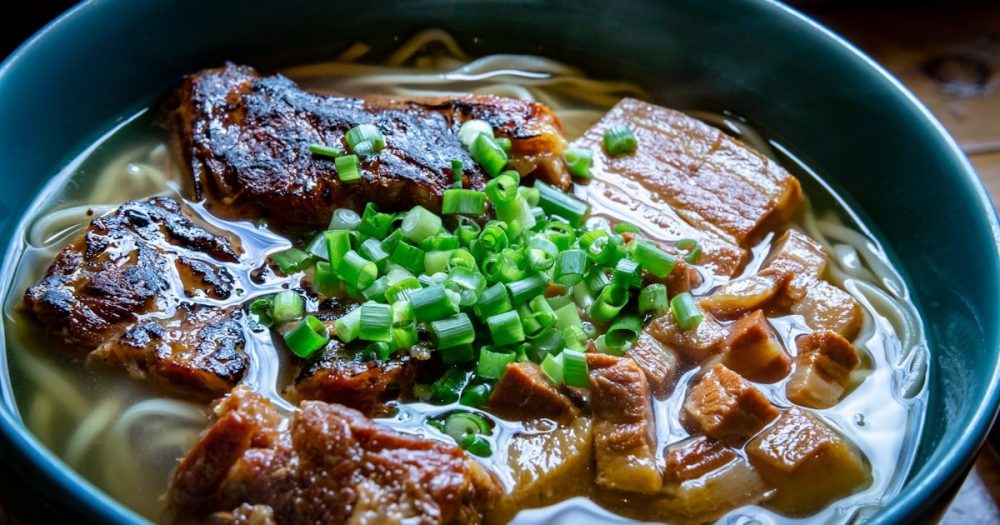
The residents of Okinawa, Japan have a reputation for outliving everyone else on earth. After Dan Buettner’s 2009 TEDx talk, “Blue Zone” entered the vocabulary of millions of people, and his Netflix documentary Live to 100 put it in front of millions more.
The pitch is clean. Okinawans eat plants. Okinawans reach 100. So eat like an Okinawan.
This way of eating has become known as the Okinawa diet.
While the diet has been celebrated as the pinnacle of proof of plant-based longevity, the centenarians were never vegetarians. Even Blue Zones concedes they ate pork.
And the numbers behind the plant-based claim came out of a survey taken in 1949.
Worth asking what was happening on Okinawa in 1949.
What is the Okinawa diet?
The Okinawa diet mimics the traditional dietary and lifestyle habits of the indigenous people of Okinawa, Japan. It leans on sweet potatoes, green and yellow vegetables, soy foods like tofu and miso, bitter melon, seaweed, turmeric, and small amounts of fish. Processed foods, refined carbohydrates, added sugar, dairy, and red meat barely appear.
It also comes with habits, not just foods. Hara hachi bu, the practice of stopping at 80 percent full. Eating with other people. Gardening into your nineties.
Here’s the part that gets skipped. The word “traditional” is doing enormous work in that definition, and nobody ever tells you which tradition, or which year they measured it.
What is a Blue Zone?
A Blue Zone is a region where people reach 100 at a much higher rate than the rest of the world. The name comes from the blue ink researchers used to circle these areas on a map, and the label stuck long after the map did.
There are five: Okinawa, Sardinia in Italy, Ikaria in Greece, Nicoya in Costa Rica, and Loma Linda in California. Okinawa is the most famous of them, and it’s the one that launched the whole idea.
Notice what a Blue Zone actually measures. It counts old people. It does not measure whether the children and grandchildren of those old people are healthy. That distinction is going to matter a lot in a minute.
What do Okinawans eat in a day?
The traditional day is built almost entirely on one vegetable. According to the dietary records analyzed by Willcox and colleagues, sweet potato supplied 69 percent of total calories. Not 69 percent of vegetables. Sixty-nine percent of everything.
By weight it came to roughly 849 grams a day. That’s almost two pounds of sweet potato, every day, per person.
A traditional breakfast looks like miso soup with tofu and seaweed, jasmine tea, and fruit. Lunch and dinner both center on champuru, a stir-fry of whatever’s around, usually with bitter melon. The famous Okinawan “superfoods” are not exotic: purple and orange sweet potato, goya (bitter melon), turmeric, mugwort, and seaweed.
Total intake ran about 1,785 calories a day, roughly 10 to 15 percent under what a person of that build would normally be told to eat.
What does the Okinawa diet avoid?
Almost everything an American eats. Refined grains, sugar, baked goods, processed oils, dairy, eggs, beef, poultry, and most fruit and nuts.
Meat is where the story gets interesting. In the 1949 records, meat and poultry came to 3 grams a day. Fish came to 15 grams. Eggs, 1 gram. Dairy, less than 1 gram.
Three grams a day is about two strips of bacon spread across an entire week.
That is a real number and it is not zero. Hold onto it.
Is the Okinawa diet actually healthy?
Yes, and the evidence for it is better than most diet research you’ll ever read.
The Okinawa Centenarian Study has run since the 1970s under Dr. Makoto Suzuki at the University of the Ryukyus, and it is the longest continuously running study of people over 100 anywhere on the planet. It didn’t survey people about what they remembered eating. It followed them.
What it found holds up. Okinawan elders showed about 80 percent less coronary heart disease mortality and 40 percent less cancer mortality than the U.S. population. Life expectancy from age 65 may be the longest in the world. Centenarians ran roughly 50 per 100,000 people, four to five times the average for most industrialized countries.
And the food itself is genuinely good food. Sweet potatoes are dense in fiber and carotenoids and cheap everywhere on earth. Turmeric and bitter melon carry real anti-inflammatory compounds. Seaweed delivers iodine, magnesium, and carotenoids almost nothing else does. Soy in its fermented, whole form is not the same product as soybean oil.
There is no fraud here. The researchers did the work, and they did it carefully.
The question was never whether these people were healthy. It’s why.
Where did the Okinawa diet data come from?
A survey conducted in 1949, under American military occupation, on an island that had just been destroyed.
The dietary figures everyone quotes trace back to a specific archival source. Willcox and colleagues cite it plainly in their 2007 paper: the Records of Health, Education and Welfare of the U.S. Office of the Civil Administrator of the Ryukyu Islands, 1949, filed under Record Group 260.12.5 at the National Archives in College Park, Maryland.
That’s not a nutrition study. That’s an occupation government counting what a conquered population had left to eat.
Four years earlier, the Battle of Okinawa ran 82 days, from April 1 to June 22, 1945. It killed roughly a quarter of the island’s population. It flattened the farms.
The livestock numbers tell it better than the casualty numbers do. Before the war, Okinawa held more than 100,000 pigs. By the Ryukyu government’s 1946 count, 7,731 remained. Other accounts put the survivors under 800. Even taking the most generous figure, that’s a 92 percent collapse in the island’s primary source of animal protein.
Pork wasn’t a garnish on Okinawa. It was the cuisine. Japan’s own Ministry of Foreign Affairs describes Ryukyuan court cooking as centering mainly on pork dishes, and the island still celebrates its native Agu pork as a delicacy. The local saying is that you eat every part of the pig except the squeal.
So in 1948, Okinawan immigrants in Hawaii raised about $47,000, bought 550 pigs, and shipped them 6,000 miles aboard the USS John Owen through storms and leftover naval mines. 536 came off at White Beach on September 27, 1948.
Ten months later, the survey was taken.
Now read the 1949 physical exam data from that same population, published in the same Willcox paper. Cheilosis, the cracked lips and mouth corners that come from riboflavin deficiency, at 10.7 percent. Delayed menstruation. Deficient lactation. A population running a negative energy balance of about 218 calories a day.
Those are the clinical signs of hunger. They were recorded alongside the diet that became a bestselling wellness brand.
And here’s what makes this worth saying out loud rather than quietly: none of it was hidden. The Willcox team published the malnutrition data themselves, in the paper that built the case. They also reported, in 2014, that Okinawa now has the highest obesity rates in Japan and that younger Okinawans have lost the life expectancy advantage entirely. In 2000, Okinawan men fell to 26th out of 47 Japanese prefectures. The prefecture’s own health department titled its report on it 26 Shock.
That’s not a research scandal. That’s a marketing one. Somewhere between the archive and the cookbook, “records of a starving island under occupation” turned into “the traditional Okinawan diet,” and the people who made that trade were selling something.
Give the counterargument its due, because serious people make it. Gavrilova and Gavrilov argue in Gerontology that the collapse in Okinawan health is straightforwardly the result of dietary westernization, and that caloric restriction really does extend human life. In the same exchange, Éric Le Bourg argues the opposite, that Okinawa is a case study in severe malnutrition harming later generations. Both of them are looking at the same island.
The correct claim isn’t that the Okinawa diet is a fraud. The correct claim is narrower and more useful. The 1949 data captures a population eating what it could get, four years after losing its animals, and calling that a chosen diet is the part that isn’t true.
So here’s the move, and you can run it on any health claim you meet this week without a lab or a subscription. Ask what year the data was collected, then ask what else was happening that year. It takes ninety seconds and it will retire more bad nutrition advice than any supplement you ever buy.
What does the Okinawa diet cost you?
Four things, stated flat.
Protein. At traditional levels you’re eating under 10 percent of calories from protein. That’s a survival number, not a thriving number, and it’s a bad fit for anyone lifting, aging, or trying to hold muscle.
Sodium. Miso and dashi are salt-forward, and some versions of the diet run above 3,000 mg a day.
Ingredients you can’t buy. Bitter melon, mugwort, and fresh Okinawan sweet potato are not at most American grocery stores. Every substitution moves you further from the thing being studied.
Everything that isn’t food. The centenarians gardened daily into their nineties, ate with the same handful of people for decades, and walked everywhere. Nobody has ever separated the diet from that. It may not be separable.
How to eat the Okinawan way
Take the parts that survive scrutiny. Skip the costume.
- Eat more tubers. Sweet potatoes are one of the cheapest, densest foods in any grocery store in America, including the big-box one you actually shop at. Roast a tray on Sunday.
- Stop at 80 percent full. Hara hachi bu costs nothing, requires no product, and is the single most portable habit on this list.
- Get the bad oils out. This is the change that shows up in every honest reading of the Okinawan data, and it’s free. Cook in butter, tallow, or olive oil.
- Keep the meat, fix the quality. Three grams a day was scarcity, not virtue. If you want pork the way Okinawans actually ate it, buy it from a local farmer whose methods you can check, pastured or woodland-raised. Skip the industrial version entirely.
- Eat with people. The moai, five or six friends committed to each other for life, may be doing more work in that data than any vegetable.
Start with one meal a week. Nobody needs a conversion.
The verdict
The Okinawa diet is a good framework wearing a bad origin story. Whole foods, small portions, no industrial oils, and a lot of tubers is a solid way to eat, and it would be solid whether or not anyone on that island ever reached 100.
What it isn’t is proof that meat shortens your life. The evidence for that came from a year when there was no meat to be had, in a place that had spent centuries eating pork and would go right back to it the moment the pigs came off the boat.
Real food wins every time. Just make sure you know who counted it, and when.