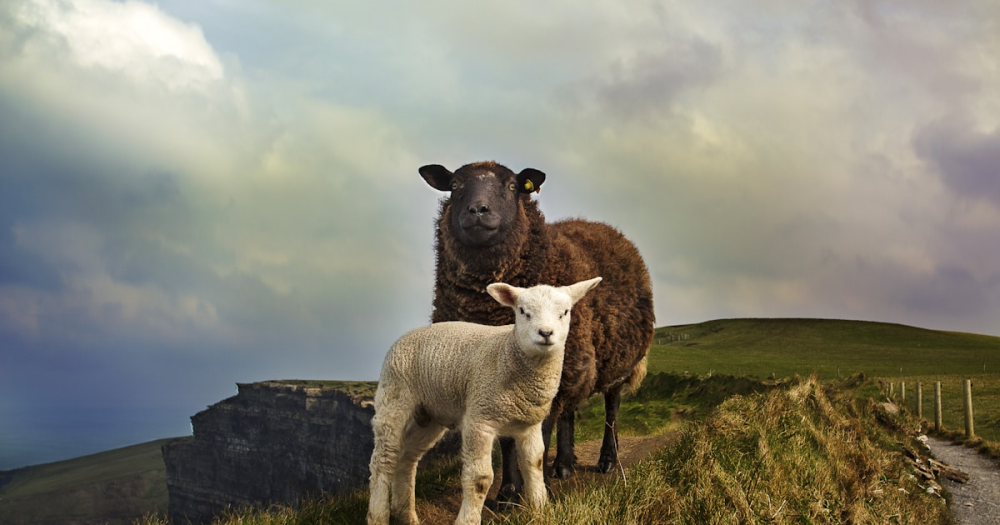
Sheep were the first animals I ever raised. A trio of Dorpers, two ewes and a ram, each about ten months old, and the ewes were already bred by somebody else’s ram. Five months later, they lambed and the cycle started over.
Almost five years on, that Dorper line is still going. It started in Utah, came east when I moved to North Carolina, and it continues in the flocks in Virginia and North Carolina, where I sold breeding stock into. The farm runs Katahdins now.
People still look at a sheep, tail hanging straight down, ears out to the side, and call it a goat. That one I’ve given up on.
The lamb question is fairer, and it’s the one worth answering properly. Because a lamb is an animal, “lamb” is also a cut of meat, and the word does not mean the same thing at the butcher counter that it means out in the pasture.
What is the difference between a lamb and a sheep?
A lamb is a sheep under one year old. That is the entire difference.
Same species, Ovis aries, same animal at two points in its life. A lamb is not a different kind of creature any more than a toddler is a different kind of human. It has milk teeth, it is smaller, it has usually not produced offspring yet, and at twelve months it stops being called a lamb and starts being called a sheep.
“Sheep” is the all-ages word. It covers a newborn, a breeding ewe, and a nine-year-old pasture ornament.
Hold onto that one-year line, though, because it is a convention rather than a fact about the animal. Several industries draw it somewhere else, on purpose, and for reasons that have nothing to do with the sheep.
What is a baby sheep called, and what are the adults called?
A baby sheep is called a lamb, and the group it lives in is a flock.
Beyond that, the vocabulary splits by sex and by whether the animal still has everything it was born with. Sheep 101, run out of the Maryland small ruminant program, keeps the cleanest terminology list available.
- Ewe lamb. A female under a year. She may become a breeding ewe or she may become dinner.
- Ram lamb. A male under a year. Same two roads.
- Ewe. An adult female. The whole operation runs on her.
- Ram. An adult intact male. Selected for what a farmer wants more of, and frequently raised out for meat anyway.
- Wether. A castrated male, usually raised for meat or wool. Wethers also get a strange side job: dosed with testosterone, they work as teaser animals that bring a group of ewes into cycle together before the real ram goes in. An untreated wether does nothing at all. The hormone is the whole trick.
How to tell a lamb from a sheep without knowing its birthday
Look in its mouth.
Sheep have eight incisors, all on the bottom jaw, biting against a hard pad up top instead of a matching row of teeth. Lambs start with small milk teeth. Then the permanent pairs push through, two at a time, from the center out. Mississippi State Extension puts it plainly: by about one year a sheep has two big adult teeth, and it takes three to four years to get all eight.
That is why sheep people talk about a two-tooth, a four-tooth, a six-tooth, and a full mouth. Nobody is guessing at birthdays out in the yard. They are reading the animal.
Age in a sheep is a physical fact, free to check, about four seconds with your hands. Everything else on the subject is somebody’s paperwork.
What do lambs and sheep eat?
Lambs start on milk and adult sheep live on grass, and the interesting part is the handoff between the two.
Newborns take nothing but their mother’s milk for the first few days. Within a week or two most of them are already mouthing at grass. Some producers set up a creep feeder, a little pen with a gap only a lamb fits through, and put grain inside so the lambs can eat without the ewes shoving in. It’s standard on commercial operations. It is not required.
Weaning generally lands between sixty and ninety days, and a good mother pushes her lambs off around four months on her own. Some won’t. I’ve lost ewes that gave their lambs everything they had and kept nothing back, and I wish I’d stepped in sooner.
Adult sheep want grass and legumes. Grain is a supplement or a bribe, never the base of the diet, because corn and other sugary grains will drop the pH in the rumen and tip a sheep into acidosis.
One thing that kills sheep and almost nothing else: copper. Sheep are the most susceptible species on the farm to copper poisoning, because their livers hoard it and barely excrete any. Feed them a mineral formulated for goats or cattle and you can lose the flock. Buy the bag that says sheep.
Is a lamb a sheep or a goat?
A lamb is a young sheep. It is never a goat.
The tail is the fastest tell. A sheep’s tail hangs down, and on most farms it gets docked short. A goat’s tail points up. Ears differ, coats differ, and the two species are not even in the same genus.
Behavior separates them too, though less cleanly than people think. Cattle graze, goats browse up high for leaves and brush, and sheep do both. Hair breeds like Dorper and Katahdin lean harder toward browsing than wool breeds do, which is one reason they get used for clearing rough ground.
What is lamb meat called, and what is mutton?
Lamb meat is called lamb, mutton is meat from an older sheep, and hogget is the in-between grade most Americans have never heard of.
The wool vocabulary works the same way. Wool off one animal is a fleece, and the fleeces from a whole farm gathered together are a clip.
For meat, the American system runs three classes rather than two. USDA sorts ovine carcasses into lamb, yearling mutton, and mutton, and the sort is done on skeletal maturity, not on a calendar. A grader checks the front shanks for a break joint, which is soft cartilage in a young animal and hardens into a spool joint as it ages.
Australia and New Zealand sort on the teeth instead. There, hogget is a sheep with no more than two permanent incisors in wear, and past that it’s mutton.
Mutton has a reputation for being greasy and strong. It can be. It also depends heavily on the breed, and mutton off a hair sheep like a Dorper, Katahdin, or St. Croix is far milder than the reputation, and good eating!
The line moves when it is worth money
On 1 July 2019, Australia changed what the word “lamb” means.
Under the old rule, an animal stopped being lamb the moment a permanent incisor broke through. Under the new one, it is lamb if it is under twelve months or if no permanent incisor is yet in wear, meaning tall enough to touch the upper pad. Same animal, same mouth, more of them inside the more valuable word.
Nothing about sheep changed in 2019. New Zealand had already moved its line, and Australian growers were losing money every time a carcass tipped over into the cheaper hogget grade. So the Australian Meat Industry Language and Standards Committee redrew the definition, agriculture minister David Littleproud announced the change by asking why Australia should hand its competitors an advantage, and the export orders were rewritten to match.
The move was not arbitrary. Meat & Livestock Australia tested eating quality on both sides of the old line first and found no discernible difference, which is what gave the committee room to shift it. That makes the new spot defensible. It does not make it a fact about sheep.
So there are at least three different lines. The everyday one at twelve months. The American one, drawn on a joint in the leg. The Australian one, drawn on a tooth, and moved by a committee when the old spot cost growers money.
None of them is the animal’s birthday.
Which brings up the objection people actually have, the one that keeps lamb off American tables: am I eating a baby?
No, and also, sort of. US lambs are typically harvested between six and twelve months, most of them at six to eight months and 100 to 150 pounds. That animal is past puberty and fully capable of breeding. It is an adolescent, not an infant.
The bird nobody agonizes over goes to slaughter at about 47 days, on the National Chicken Council’s own numbers. Under seven weeks. We call that chicken and think nothing of it.
That’s not squeamishness on the shopper’s part, and it isn’t hypocrisy either. It’s a word doing what words do when an industry gets to pick them. “Chicken” tells you nothing about age. “Lamb” sounds like it does, and doesn’t.
What to do when you buy lamb
You do not need a grading manual. You need a couple of questions and a willingness to buy the thing nobody else wants.
- Ask the farmer when it was born and when it was harvested. Any direct-market producer knows both dates without checking. It’s a friendly question and the answer tells you more than any label on the package.
- Ask what it ate after weaning. Grass the whole way, grain-finished, or something in between. This changes the meat far more than two months of age does.
- Buy hogget or mutton on purpose. It’s cheaper, there’s more of it per animal, and from a hair breed it is genuinely good. Braise it. Ask a butcher who is not afraid of the word.
- If you’re buying a live animal, check the mouth. Two big teeth up front means you’re past lamb, whatever the seller calls it.
- Buy the grocery store lamb if that’s what’s available. It is a real animal raised by a real farmer. Nobody has to shop perfectly to eat well.
People kept sheep for thousands of years before anyone wrote a grading standard, and they managed. They looked at the animal.
You can still do that. Ask your questions, take the mutton nobody else wants, and go meet the person who raised it. There’s a lamb crop hitting the ground somewhere near you every spring, and around dusk the whole batch of them will tear around the pasture in a lap for no reason at all. We call it the lamb derby. It’s the best part of the job!