
A few years ago my wife and I took a trip to London and spent a week hopping across the various museums and tourist traps. Across London and the rest of the country, we were surprised at the constant everyday reminders of WWII. Not a day went by where I didn’t see a plaque, or a statue, or a memorial to the Blitz, or Churchill, or any other aspect of the war. As an American, it was reverent and stirring.
Britons remember the sacrifice and the victory every day, generations later.
I find that Americans reflect on WWII as a righteous war, and indeed it was. But even a righteous war is terrible.
“It is well that war is so terrible, otherwise we should grow too fond of it.” – Robert E. Lee
Through the terror of loss of life, WWII forced innovation. Which too, comes at a cost.
“I know not with what weapons World War III will be fought, but World War IV will be fought with sticks and stones.” – Albert Einstein
The use of atomics has been kept at bay. But the technology the war built is still running, and a lot of it is running on your dinner plate.
The United States feeds the world
When the war ended, America was left with an industrial base built to make two things at scale: munitions and shelf-stable food.
That wasn’t an accident of history. It was the assignment. At a Kremlin dinner in 1941, Stalin raised a toast to American industry and said the war would be won by industrial production, singling out motor and oil output. The American ambassador cabled it back to Washington, which is why we have it in the record instead of in a memoir.
Then the shooting stopped, and the factories didn’t.
The federal government had built ten new ammonia plants during the war, sited inland near natural gas pipelines, because ammonia is the front end of an explosive. By 1945 they were turning out 730,000 tons of ammonia a year with capacity for 1.6 million. The entire American ammonia industry existed because somebody needed to fill bombs, and after the war the output of those plants transitioned into nitrogen fertilizer.
The pivot has a date and an address. In 1947, the enormous munitions works at Muscle Shoals, Alabama switched from explosives to fertilizer. Before anyone landed on farmland, there was a serious proposal to spray the surplus over America’s forests to help the timber industry.
Same white pellet. New customer.
Why the fertilizer worked
Here is the part that has to be said without flinching: synthetic nitrogen is one of the most consequential things our species has ever made, and it worked.
Before Haber-Bosch, a farm’s nitrogen came from manure, legumes, and whatever you could recycle back into the ground. That’s a closed loop with a hard ceiling. Vaclav Smil’s estimate is that without synthetic ammonia we could not grow roughly half of today’s world food, and that two of every five people currently alive would not be here. A later analysis in Nature Geoscience put the figure at 48 percent of the global population as of 2008.
Two of every five. Not a rounding error. Somebody in your family.
So nobody serious is asking for the fertilizer to go away. The question is a different one, and it’s the one nobody asked in 1947. What happens to a country when the cheapest input it owns is the one that lets you skip everything else?
Who actually told farmers to get big
The policy showed up more than twenty years after the chemistry did.
This is the part of the story that usually gets compressed, and compressing it hides the mechanism. Earl Butz is the name attached to American farm consolidation, and he earned it. But Butz was only assistant secretary of agriculture in the 1950s, under Eisenhower. He went back to Purdue in 1957. It was Nixon who appointed him secretary in 1971, and everything he’s famous for belongs to the 1970s. “Get big or get out.” Plant fencerow to fencerow. Turn every acre into a cultivated crop.
Worth saying plainly: nobody has yet produced a recording, a transcript, or a newspaper clipping of Butz saying “get big or get out.” Wendell Berry pinned the line on Ezra Taft Benson in 1977, Michael Pollan later pinned it on Butz, and a historian who went looking for the original found no first-hand evidence for either man. That’s how a lot of history works. The line got said, it got repeated, it got believed, and it got carried out. Farmers heard it. Policy followed it. Whether it left one particular mouth on one particular day matters less than the fact that it became the instruction.
Now look at the order of events.
The infrastructure came first, and the policy arrived a generation later to feed it. Ten ammonia plants, converted by 1947. Chemical fertilizer cheap and everywhere through the fifties and sixties. And then, in 1971, a secretary of agriculture telling farmers to tear out the fencerows and plant to the property line.
We didn’t decide to farm this way and then build the tools. We built the tools for a war, kept them, and then wrote the farm policy that would use them up.
What American farmland grows now
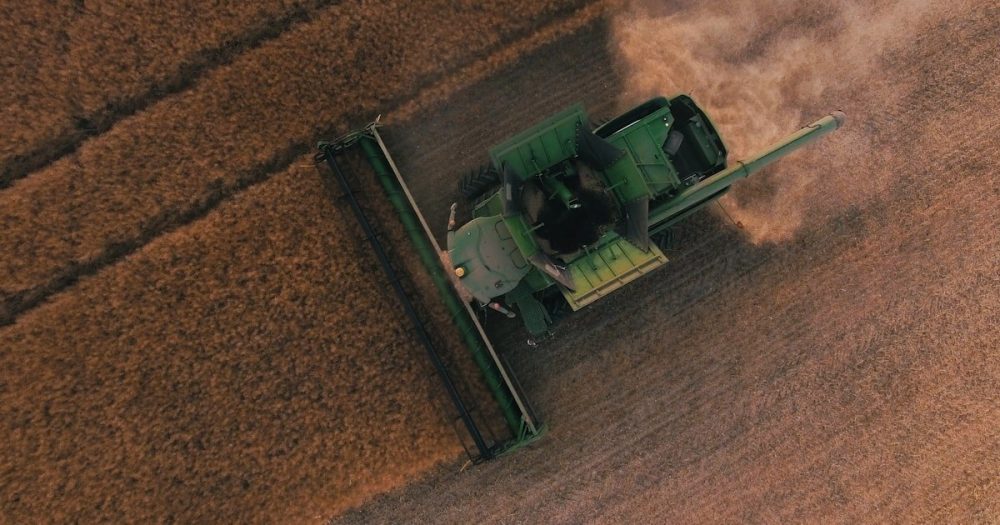
Most of it doesn’t grow food.
The United States plants around 95.3 million acres of corn and 85.4 million acres of soybeans. Total American cropland is roughly 328 million acres. Two crops, more than half the farmland in the country.
And then where does it go? In 2020, 35 percent of American corn was grown for animal feed, 31 percent for biofuel, and less than 2 percent for direct human consumption. Count generously, adding in the corn that becomes high-fructose corn syrup, sweetener, and starch, and USDA figures still put only 9 percent into human food and ingredients. Soybeans run about 8 percent.
Drive through Iowa in August and you are looking at fuel, feed, and syrup. Almost none of it is dinner.
One habit worth stealing here, because you’ll need it the next time somebody hands you a farm statistic. Ask what country the number is from. An enormous share of the alarming figures about farmland are global averages quoted as if they were American, or American figures quoted as if they were global, and the two often point opposite directions. If a statistic arrives with no country attached, assume global and go find the domestic version. It takes ninety seconds and it changes the answer more often than you’d think.
“The nation that destroys its soil destroys itself.” – Franklin Delano Roosevelt
FDR wrote that to every state governor in February 1937, with the dust still in the air. I wondered if he knew how prophetic he was being. Did he understand that the leaders he was addressing would be the ones to shape that reality?
What the yield cost us
Soil first, because the soil is measurable and the measurement is grim.
Researchers at UMass used satellite and LiDAR data to map where the dark, organic-rich A-horizon is simply gone across the Corn Belt. Their finding, published in PNAS in 2021, is that 35 percent of the cultivated area has lost it completely, a figure prior soil surveys had missed entirely. That’s 1.4 petagrams of carbon off the hillslopes, a 6 percent hit to yields, and $2.8 billion a year.
Two details in that paper deserve more attention than they get. The loss concentrates on convex hilltops, which is the signature of tillage rather than water. And tillage erosion isn’t included in the models the United States uses to track its own soil. We have been grading our homework with the hardest question left off the test.
You can see it from a plane. Those pale streaks running along the crowns of the hills in Iowa are the subsoil, showing through where the topsoil used to be.
Now taste, which is the part everybody notices and nobody can prove at the dinner table. Researchers at Florida ran 398 tomato varieties through chemical analysis and consumer panels and found modern commercial varieties carry significantly less of the chemistry that makes a person like a tomato. The paper names the reason without embarrassment: we bred for yield, shelf life, firmness, and shipping, and we did not breed for flavor.
Nutrition is the messier claim, and it gets stated with its mess attached.
The study everybody cites compared USDA composition data for 43 garden crops between 1950 and 1999. As a group, six of thirteen nutrients declined reliably, from 6 percent for protein up to 38 percent for riboflavin. That’s a group finding pulled from a database, not two carrots on a scale, and the authors said so. Most individual foods couldn’t be told apart from no change at all, and about 28 percent of the ratios went up.
The strongest objection comes from a critical review in the Journal of Food Composition and Analysis, and it lands. Comparing food tables published decades apart is unreliable, because the labs, the instruments, the cultivars, the sampling, and the statistics all shifted underneath the numbers. More pointedly, where matching archived soil samples exist, they show mineral content has not declined in intensively cultivated ground under heavy fertilizer.
So the simplest version of this story, the one where fertilizer empties the dirt and the dirt empties the broccoli, doesn’t survive contact with the evidence. Good. Say it out loud and keep going, because look at what both sides agree on.
The 1950-to-1999 authors’ own explanation for any real declines was changes in cultivated varieties, “in which there may be trade-offs between yield and nutrient content.” The tomato paper says yield, shelf life, and shipping. Neither one blames the soil. Both of them blame the breeding target.
We told the entire system to maximize yield, and it did exactly that. Everything else in the plant was a rounding error to the instruction. Bigger, harder, faster, further, and if a little flavor and a little protein fell out along the way, no bushel counter anywhere in the country was set up to notice.
Get big or get out was a yield instruction. This is what a yield instruction produces.
So where does the blame deserve to go?
Not at the people running the system 70 years ago. I believe recent and current leaders who are unwilling to look beyond the glaring hubris of our sustained actions are to blame.
And not at farmers. A farmer buying anhydrous ammonia in 1974 wasn’t being reckless with the country’s topsoil. He was being solvent. The secretary of agriculture said get big, the lender agreed, the elevator paid by the bushel, and the fertilizer was the cheapest thing on the invoice. That’s not a character flaw. That’s a man responding correctly to every signal he was given.
The signals were built by people with names, and those people were not farmers.
But I’ve given up on leaders making changes for good just because it’s the right decision. I think the power of an educated consumer is the biggest arrow in the quiver of a sustainable American food system. Consumers need to vote with their dollar, because at the end of the day, nothing speaks louder than money.
What can you do?
Start with one thing, not eleven. The list below is roughly in order of how much it changes for how little it costs you.
- Shop local, at your farmer’s market. Get to know your farmer, their methods, and buy what grows around you. Ask one method question and let them talk. Most of them are thrilled somebody asked.
- Grow one thing. Even in an apartment, an indoor herb garden on a south-facing window will teach you what it takes to grow food. Then you’ll never look at a $4 clamshell of basil the same way again.
- Eat what’s in season, which usually means going back to that farmer’s market.
- Read labels for the method, not the mood. Pasture-raised eggs over vegetarian-fed eggs. The label that tells you what the animal ate and where it stood beats the label that just sounds wholesome.
- Buy the thing that was bred for flavor. If a tomato has a variety name on it, somebody chose it for a reason other than how well it survives a truck.
- Cut the competition. Ditch the processed stuff, the seed oils, and most anything with an expiration date more than two years out.
Here’s the honest cost, so you’re not surprised by it. This is more expensive per calorie and it takes more cooking. Nobody is going to do all of it. I shop at big-box stores like everybody else, and a person feeding four people on a fixed budget is not going to get all their protein from a farmer’s market, and shouldn’t be made to feel like a failure for it.
And the fertilizer isn’t going anywhere, nor should it. Two of every five people need it. The realistic ask is not abolition, it’s a system that stops treating yield as the only number worth counting, and that starts with buyers who count something else.
The close
Britain put up plaques. We put up grain bins.
Both are monuments to the same war. One of them we visit on purpose, and the other one we drive past at seventy miles an hour without knowing what we’re looking at.
The soil under the Corn Belt is the last piece of that war still being spent, and unlike the rest of it, we get a vote. Not in November. On Saturday, with a twenty in your hand, in front of somebody who can tell you exactly what they did to the ground.
Go find them. And thank a farmer while you’re there.