
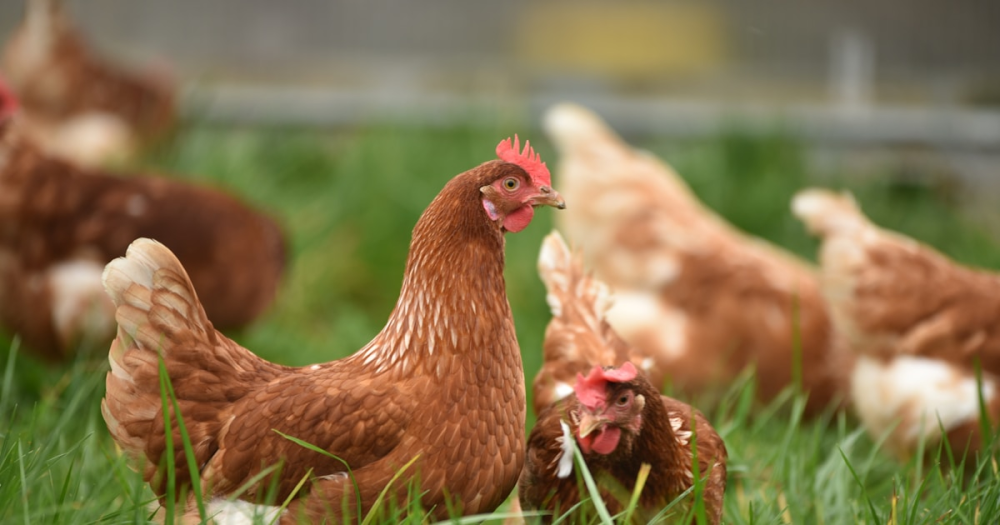
The chicken you ate this week was 47 days old.
Not months. Days.
In 1925 that same bird went to market at 112 days weighing two and a half pounds. Today it goes at 47 and weighs six and a half. Same animal, less than half the time, more than twice the meat.
So there are two questions hiding inside the one people type into Google. How long can a chicken live, and how long does a chicken actually get. Those two answers are about a hundred times apart, and almost nobody tells you which one they’re answering.
Let’s do both.
How long do chickens live?
A chicken lives 5 to 10 years. With good genetics, a secure coop, and a little luck, backyard hens reach 8 to 12, and a few go well past that.
The record holders show you the ceiling. The oldest chicken ever verified was Muffy, a Red Quill Muffed American Game hen from the United States who reached 23 years and 152 days before she died in 2012. The most recent holder of the oldest living chicken title, a bantam named Peanut, died at 21 after spending her last winters indoors sharing a cage with her own 15-year-old daughter. Twenty-one years out of an egg her owner had already picked up to throw in the pond!
Worth saying plainly: nobody has run a proper study on how long backyard chickens live. There’s no cohort tracking ten thousand hens from hatch to death. The 5 to 10 range is pooled keeper experience and vet observation, repeated until it hardened into a fact. It’s the best number available and it is not a measurement.
How long do chickens live by breed?
Heritage breeds outlive production hybrids, and the gap is real.
Here’s the honest caveat first: these are ranges keepers report, not published averages. Nobody funds longevity trials on Wyandottes.
- Rhode Island Reds, Plymouth Rocks, Orpingtons, Wyandottes. Six to ten years, sometimes more. These are the old dual-purpose breeds. They grow slowly, start laying later, and lay fewer eggs per year, and every one of those traits buys them time.
- Silkies, Polish, and other bantams and ornamentals. Seven to twelve years. Small bodies, low egg output, usually kept as pets and protected accordingly. Peanut was a bantam. So was Matilda, the first record holder, who died at 16.
- Leghorns. Four to eight years. Bred hard for egg volume, and it costs them.
- ISA Browns, Golden Comets, and other production hybrids. Two to five years. These birds were designed to lay 300 eggs in their first year. Reproductive tract cancers, prolapse, and osteoporosis show up early and often.
- Cornish Cross. Weeks. Not a breed, a hybrid, and we’ll get to why that matters.
The pattern underneath the list is the whole thing. Output and lifespan trade against each other. A hen only has so much calcium and so much protein to move around, and a bird laying an egg nearly every day is spending both faster than a bird laying eighty a year.
Do hens and roosters live the same amount of time?
Yes, roughly. There’s no good evidence of a built-in difference between the sexes in chickens.
What differs is exposure. A rooster puts himself between the flock and whatever’s coming, which is exactly what you want him to do and exactly what gets him killed. And in a flock with too few hens, roosters fight each other, sometimes to the death. The old rule of thumb is one rooster to eight or ten hens, and it exists mostly to keep the boys from killing each other and the girls from getting worn ragged.
How long do laying hens live?
A hen lays her first egg at 18 to 20 weeks and can keep laying, at a declining rate, for six or seven years.
Commercial hens do not get six or seven years. They get about a year and a half. Egg production peaks around 30 weeks and slides from there, and when a flock drops to roughly 50 percent lay, feed cost meets egg price and the math stops working. At that point most producers molt the flock to restart it. NC State Extension puts the average molt at 69 weeks of age and notes that over 80 percent of caged egg-type hens in the United States get molted. After the second cycle winds down, usually somewhere past two years, the hens are sold as spent.
Nothing about that number is biological. A hen at 78 weeks is not old. She is unprofitable, which is a different condition entirely.
Your backyard hens will slow down on the same schedule and then just keep living. A four-year-old hen laying two eggs a week is still turning grasshoppers into breakfast, still eating ticks, and still putting nitrogen where you want it.
How long do meat chickens live?
Forty-seven days.
That’s the Cornish Cross, and it is the only chicken most Americans have ever eaten. It isn’t a breed. It’s a hybrid of Cornish and White Rock lines that doesn’t reproduce itself, so every one is bought as a chick from one of three companies that supply nearly the whole world. University of Maine Extension notes these crosses hit five pounds in six or seven weeks, and that the growth rate stresses their legs and hearts enough to kill some of them if you aren’t watching.
The best evidence on that comes from a survey of 176 commercial flocks in which trained veterinarians gait-scored 51,000 birds representing 4.8 million. At an average age of 40 days, 27.6 percent walked poorly and 3.3 percent were barely able to walk at all. That’s a 2008 study on UK flocks, so it’s neither current nor American, and it’s still the largest and cleanest measurement anyone has published. The authors found the leading risk factors were the ones tied to growth rate.
Slower-growing alternatives exist and they take longer on purpose. Red Rangers and similar birds need 11 to 13 weeks to reach the same job. Roughly twice the time, roughly twice the feed bill, and a bird that can still walk to the water line on its last day.
What actually kills a backyard chicken?
Not old age. Predators and disease, in that order.
Believe it or not, the most common predator on my place has been raccoons. They’re the frustrating ones because they don’t even eat the birds, they just kill them and leave the carcass. I take the carcass out to a spot in the woods, and every time, it’s gone by morning.
You do everything you can, and then you accept some of it as a tithe to nature.
Disease is the other half, and the one you have real control over. Marek’s disease is the big one in backyard flocks, and it arrives on birds that look perfectly healthy. University of Tennessee Extension recommends quarantining any new bird for 30 days at 30 feet from your existing flock, a hundred feet if you can manage it. Bringing in birds from someone else’s flock is the fastest way to wreck your own.
How long does the average American chicken live?
In 2025, American plants slaughtered 9.58 billion young chickens. They slaughtered 106 million mature ones.
Ninety-nine out of every hundred chickens that go through a US plant are broilers, and a broiler is 47 days old. Weight the average by how many birds there actually are, and the lifespan of an American chicken is about seven weeks.
Every page telling you chickens live 5 to 10 years is describing a bird that fewer than two percent of American chickens ever get to be.
That’s not a scandal on its own. I raise broilers. Mine spend nearly their whole lives on grass under a chicken tractor that gets pulled to fresh ground once or twice a day, and they still go at a set weight, because that’s what a meat bird is for. The laying flock scratches around in the annual run under the figs, blackberries, and elderberries, where there’s shade and white clover to keep them busy. Livestock means deadstock. Food is the result of death, and pretending otherwise is how you end up with a farm that doesn’t feed anybody.
The thing worth noticing is what sets the date. Not the bird’s body. A feed conversion ratio, a contract weight, and a break-even point on egg price. The United Egg Producers standard for a caged hen is 67 square inches, about a dinner plate, and a hen who has to live her entire productive life on a dinner plate is not going to have a long one.
None of that is the grower’s doing. Almost none of them set those numbers, and most would happily grow a slower bird if the contract paid for it. The people who set the date are the ones who write the contract.
So here’s the move, and you can run it on any animal, anywhere, in about ten seconds. When a source gives you a lifespan, ask whether that’s how long the animal can live or how long it’s allowed to live. Those are different sentences. Almost nobody says which one they mean.
How to give a chicken a long life
If you keep chickens and want them around a while, the levers are short and they’re not expensive.
- Pick the breed on purpose. A Rhode Island Red or an Orpington will outlive a production hybrid by years. You’ll get fewer eggs. That’s the trade and it’s a fair one.
- Quarantine every new bird for 30 days. Free, and it’s the single highest-return thing on this list.
- Build the coop for the predator, not the weather. Hardware cloth, buried apron, a door that latches against something with hands. Raccoons have hands.
- Get them onto grass. Bugs, greens, sunlight, and room to move. Chickens are not vegetarians, whatever the carton says, and a bird on pasture will hunt insects and worms all day. A bird eating what it evolved to eat is a healthier bird.
- Let the old hens retire. A hen past her laying years still eats ticks, still makes compost, and still runs the pecking order. Or put her in the stock pot. Both are honest.
If you don’t keep chickens you still get a vote. The bird that lived 47 days and the bird that lived 12 weeks on pasture cost different amounts, and the difference is time.
So find out how old the chicken in your cart was when it died. If the label won’t say, the grower at the market on Saturday will.