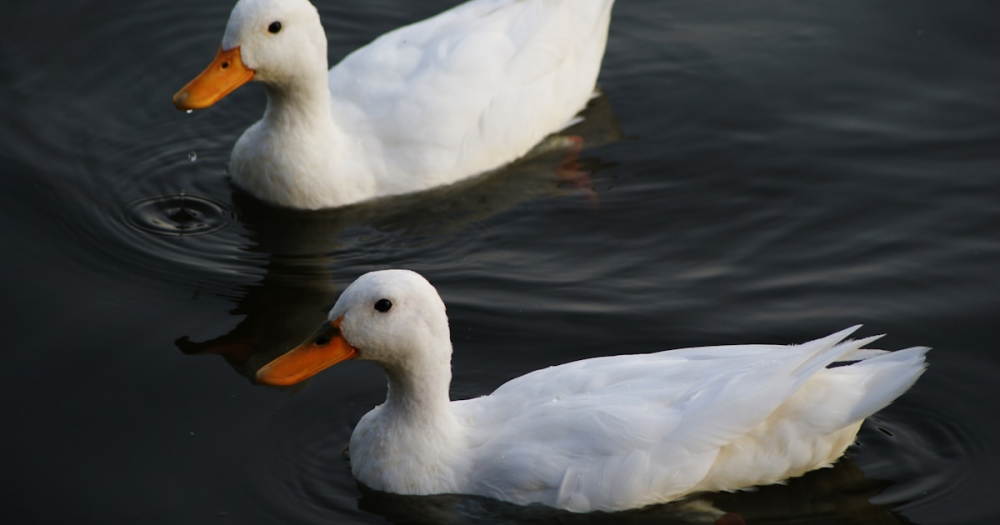
Picture a duck. Not a mallard, not a wood duck. Just a duck, the cartoon one, the one on the insurance commercial.
White body. Orange bill. Orange feet.
That’s a Pekin. It’s the bird Donald Duck is drawn from and the bird in the Aflac ads, and the USDA counted 27.5 million ducks harvested commercially in a recent year, the overwhelming majority of them this one white animal.
It did not win that job on flavor.
What is a Pekin duck?
A Pekin is a heavy white meat duck developed in the United States from Chinese stock, raised mostly for the table and named for the city its ancestors came from.
Every domestic duck except the Muscovy descends from the wild mallard, domesticated in China roughly 3,000 years ago. Chinese breeders were very good at this. Among the birds they produced was a duck called shi-chin-ya-tze, which translates roughly to “ten-pound duck.” That’s the animal the American Pekin comes from.
The breed at your local hatchery is the American Pekin, recognized by the American Poultry Association in 1874. There’s also a German Pekin, bred from the same Chinese birds but crossed with upright white ducks brought over from Japan, which gives it a much steeper stance. Same origin, two very different-looking animals.
Which is the first hint of what this breed actually is.
Pekin duck or Peking duck?
One is a bird and one is dinner, and the spelling difference is an accident of the 1890s.
The dish came first by a wide margin. Roast duck traveled to Beijing with the Ming court in the early 1400s, and the restaurants that made it famous, Bianyifang and Quanjude, opened in 1416 and 1864. Beijing chefs bred a local white-feathered duck for it, prized for thin skin and tender flesh.
So why two spellings for one city?
Because English couldn’t make up its mind. Portuguese traders wrote Pequim, which came into English as Pekin and into French as Pékin. The Jesuit Martino Martini used Peking in 1654. Both spellings stayed in ordinary use until the 1890s, when the Chinese Imperial Post picked Peking and made it official.
The ducks landed in America in 1873. They got the older spelling and kept it. The dish standardized later and got the newer one.
Both sound about the same out loud, which is why nearly everyone says “Peking” when they mean the bird. Nobody minds.
What Pekin ducks look like, and how big they get
Creamy white plumage, a rich yellow bill, orange-yellow legs, and a broad deep breast built to carry meat. The American Poultry Association standard is 9 pounds for the drake and 8 for the duck. Show birds and jumbo strains run heavier.
They can’t fly. Not “usually don’t.” The frame is simply too much bird for the wing, and that’s genuinely convenient, because you’ll never clip a feather.
Telling drakes from hens takes patience. Two reliable signs show up as they mature:
- The drake feather. A few feathers on top of the tail curl forward. Nothing else on the bird does this.
- The voice. The loud, classic quack comes from the hen. The drake’s call is raspy and quiet, almost a whisper.
Ducklings look identical for the first several weeks, so don’t try to call it at two days old.
How many eggs do Pekin ducks lay?
A Pekin hen will lay over 150 white eggs a year, and good ones do considerably better. The eggs are large, roughly a third bigger than a chicken egg, with a thicker shell and a much richer yolk. Bakers love them for exactly that reason.
Murray McMurray, which sells the birds and has every reason to talk them up, says a Pekin hen starts laying at five months and warns in the same breath that Pekins are poor sitters and unreliable mothers. Take that second half seriously. It’s a seller volunteering a reason to buy something else, and they name Muscovy and Welsh Harlequin as the breeds that will actually hatch their own.
What to feed Pekin ducks
Waterfowl feed if you can get it. Chick starter will get your ducklings into trouble.
Here’s why, and it’s the most useful thing on this page. Ducks need far more niacin than chickens do. The National Research Council puts ducklings at 55 mg per kilogram of feed against 27 to 35 mg for chicks, a figure a commercial feed formulator confirmed for Metzer Farms, a hatchery that also happens to sell niacin supplements. The peer-reviewed husbandry literature runs higher still, at 60 to 80 mg per kilogram. Ducks also convert tryptophan into niacin poorly, so they can’t make up the gap internally.
Now the part that ties the whole bird together. Corn contains niacin, about 24 mg per kilogram of it, but almost none of that is available to the animal. Feed formulators run the number at 2.
So the bird America raises on corn is a bird that can barely use corn’s niacin. Fix it with brewer’s yeast or nutritional yeast mixed into the feed, or plain niacin in the water. A duckling that goes short sits back on its hocks, bows at the legs, and eventually can’t walk.
Two more rules, both out of the same husbandry literature:
- Skip medicated chick starter. Anticoccidials can be toxic to ducks, and ducks kept clean rarely need them.
- Nothing moldy, ever. Pekins are extraordinarily sensitive to aflatoxin. As little as 0.1 mg per kilogram of feed measurably damages growth, liver function, and immune response in ducklings.
Oyster shell free-choice once the hens are laying, and that’s most of it.
Do Pekin ducks need a pond?
No. They need water they can get their whole head into, which is a much smaller ask.
A duck bathes to keep its feathers working. Head-dipping, wet preening, and splashing spread oil and clear the eyes and nostrils, and a Pekin with no way to do any of that gets crusty and miserable. A kiddie pool you dump and refill does the job. So does a mortar tub.
They’ll also make an unbelievable mess of it. Ducks slosh feed around in water before swallowing, so whatever you set out turns to soup inside a day. That isn’t a flaw you can manage away. That’s a duck.
If you do have a pond and let them use it overnight, they’re far safer on the water than on land, since foxes, raccoons, and coyotes won’t swim after them.
How long do Pekin ducks live, and are they good pets?
A Pekin can live 8 to 12 years. Plenty don’t.
They’re wonderful company, and that part is real. Calm, curious, funny, and loud in the best possible way. If you want a bird with a personality that follows you around the yard, this is a strong candidate!
But a Pekin was built to reach slaughter weight in about a month, and a body optimized that hard for early growth carries that optimization for the whole rest of its life. Heavy frames on webbed feet mean leg and foot trouble as the years stack up, especially on wet ground and especially in birds that get fat.
I’ve kept both, and the hardest part about keeping ducks alive is keeping them safe. Chickens are much more aware of threats, and will do more to protect themselves. The ducks I’ve raised are terrible at putting themselves to bed at night, whereas a chicken will find safety in the coop. The ducks need to be corralled in at dusk every night.
Plan on that. Every night, forever.
Why the Pekin beat every other duck
The actual story has almost nothing to do with taste.
In 1872 a man named James E. Palmer, of Stonington, Connecticut, loaded fifteen white Chinese ducks at Shanghai for a businessman named McGrath. The voyage took 124 days and reached New York on March 13, 1873. Nine birds survived it. Five went on toward McGrath and were eaten before they got there.
Four ducks. That’s the foundation stock for the entire American duck industry.
They spread fast, and the breed they displaced tells you why. The American meat duck before 1873 was the Cayuga, which had one commercial problem: dark feathers. Any fluff left on a plucked carcass showed. The white Pekin plucked clean. The same thing happened in Britain to the Aylesbury, and the verdict at the time was blunt. Pekin meat was thought poorer eating than the Aylesbury’s, but the bird was hardier and cheaper to raise, so breeders switched anyway.
That’s a market signal, and it’s worth reading as one. A buyer at a loading dock can see feather color and can read a scale. He cannot taste anything. So the traits that got selected were the ones a buyer could verify without cooking, and flavor went along for the ride.
Then geography finished the job. Long Island was the American duck capital for eighty years, ponds and all. In 1958 a feed mill owner and former commodities trader named Donald Wentzel decided the industry was simply in the wrong place and started Maple Leaf Farms in northern Indiana, on the reasoning that it was cheaper to move the ducks to the corn than the corn to the ducks.
It worked completely. Maple Leaf and its neighbor Culver Duck now account for about 75 percent of US duck production, and Maple Leaf’s co-president Scott Tucker has said flatly that his company uses only the white Pekin, which he puts at 90 percent of the ducks bred worldwide. Take that as a company describing its own dominance, which is the kind of claim a company tends to get right.
The finished product of all that selection is a bird that hits 3 to 4 kilograms in four to five weeks indoors, on corn and soy, drinking from pin-metered nipple lines rather than open water. The industry’s own recommendation is nipple lines, and the stated reason is contamination risk to the birds and to people, not cost. Oxford researchers who surveyed 46 commercial flocks found gait and cleanliness scores worsening with wetter litter and higher ammonia, which is the honest tension. Give a water bird open water indoors and the floor gets wet, and wet floors wreck feet. There’s no free answer in there.
None of this was cynicism. Wentzel was a feed man who noticed the ducks were a thousand miles from their feed, and he was right. Palmer shipped ducks. The breeders who dropped the Cayuga were answering the customer standing in front of them. Every link in that chain made sense to the person forging it, and the chain still ends with a water bird raised next to a grain elevator.
Which hands you a question you can use on any animal, anywhere, in about ten seconds. What was this breed selected for? Because that tells you what it was selected away from. Fast growth and a clean white carcass are what the Pekin was bred toward. Foraging, broodiness, longevity, and flavor are what got left on the table.
Getting started with Pekins
- Buy waterfowl starter, not chick starter. If your feed store only stocks chick feed, mix brewer’s yeast into it before the ducklings ever eat.
- Set the water up before the birds arrive. A kiddie pool and a plan for dumping it, sited where the runoff won’t turn your coop into a swamp.
- Get at least two. A lone duck is a sad duck.
- Lock them up at dusk. They will not do it themselves.
- Decide up front what these birds are for. A Pekin raised for meat at seven or eight weeks is doing exactly what it was built for. A Pekin kept for nine years is doing something it wasn’t, and you should expect to manage feet and legs.
- Want a duck that hatches its own eggs or forages hard? Look past the Pekin. Muscovy hens go broody and raise their own. Runners lay like machines. Welsh Harlequins do both.
And if the duck in your freezer is a grocery-store Pekin, roast it. Render the fat and keep it in a jar in the fridge, because it’s one of the best cooking fats there is and it cost you nothing extra. There’s no purity test here.
Just know what you’re holding. The white duck with the orange bill is a good animal that got very good at one narrow job, and the job was picked by men at loading docks a hundred and fifty years ago.
Go find a grower and ask what their birds were bred for. They’ll love the question.