
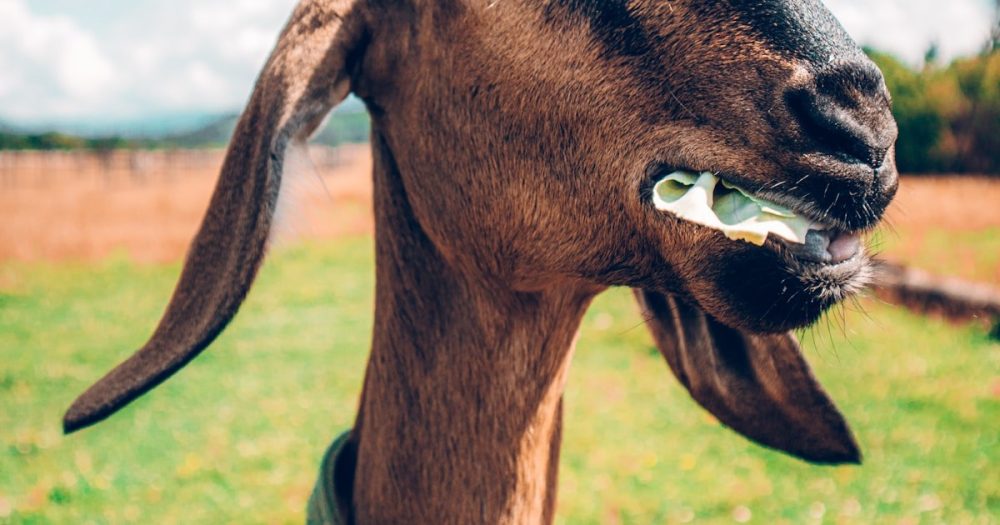
Sixteen dairy goats were offered a choice. Fresh cut grass in one feeder, poplar leaves in the other.
In the second run of the experiment they ate 191 grams of leaves and 0.231 grams of grass.
Not a little grass. A quarter of a gram. A rounding error.
I’ve had a few goats on my homestead from time to time, and that result matches everything I’ve watched them do. They’re charming, resourceful, mischievous, and far pickier than their reputation suggests.
That reputation is the problem. You know the one. Goats eat tin cans, laundry off the line, the hat off your head.
They don’t. But something true is buried in the folklore, and digging it out is the difference between a goat that thrives on your place and a goat that dies on a Tuesday afternoon for no reason you saw coming.
What do goats eat?
Goats browse. Leaves, green twigs, vines, shrubs, bark, and broadleaf weeds, with grass a distant afterthought, hay standing in when browse runs short, free-choice minerals, and clean water.
That’s the list. All of it.
Goats are ruminants, which means four stomach compartments, the largest being the rumen, where microbes ferment plant fiber into something a mammal can actually use. University of Arkansas extension puts the rule of thumb at 2 to 4 percent of body weight in dry matter per day. Grain is optional and usually unnecessary. Treats are treats.
Everything else you’ll read about feeding goats is a footnote to that paragraph. The rest of this page is about the gap between what a goat needs and what a goat usually gets.
Are goats grazers or browsers?
Browsers, and it isn’t close. Cows and sheep are grazers, built to work a sward with their heads down. Goats work upward.
Researchers have recorded goats browsing to 2.1 meters, more than twice their own body height. That’s the animal you’ve seen with its front hooves propped on a fence post, stretching for a leaf it has no business reaching.
There’s a reason beyond stubbornness. Eating at eye level keeps a goat alert, and more usefully, keeps its mouth away from the bottom few inches of pasture where worm larvae live. Height is a parasite strategy.
Browse is also just better feed. In that New Zealand trial the poplar leaves carried roughly a third less fiber than the grass and nearly twice the soluble sugars.
So when a goat ignores your beautiful pasture and strips the hedgerow instead, it isn’t being difficult. It’s reading the feed analysis better than you are!
Do goats eat grass?
Goats will eat grass, but they treat it as the option of last resort. In that same trial, 22 tests ended with a goat eating nothing at all, and all but one of those happened when grass was the only thing on offer.
Given nothing but grass, some goats would rather stand there.
This is the most common setup mistake I see. Somebody fences a nice green half-acre, turns goats out on it, then can’t work out why the animals spend all day walking the fence line looking for a way into the woods. That paddock is a sheep pasture. Goats want a brushy, weedy, half-wooded mess, which happens to be exactly the ground most of us are already paying somebody to clear.
Can goats eat poison ivy?
Yes. Goats are unaffected by urushiol, the oil that gives the rest of us the rash, and Penn State Extension notes they’ll readily strip poison ivy foliage, though not the roots. Repeated browsing is what actually knocks a patch back.
If you keep dairy goats, the obvious next question got answered at UC Davis. Urushiol does not pass into milk from goats eating poison oak. Keep drinking.
One practical warning, and it isn’t a joke. When a hired herd cleared poison ivy along a trail in Austin, the public was told not to pet the goats, because their coats were slick with the oil. The goat is fine. Your forearms are not.
The catch is the thing Penn State says out loud and every goat owner learns the expensive way. Goats don’t distinguish between the plants you want gone and the plants you paid for. They’ll take the poison ivy and your blueberry bushes in the same pass.
What fruits and vegetables can goats eat?
Most of the produce in your kitchen is safe for goats in small amounts, and the operative words are small amounts.
- Apples, pears, peaches. Fine cut up. Never free choice, and never a windfall pile under a tree.
- Bananas, peel included. Sweet, so treat them like candy.
- Carrots, turnips, beets. Good treats, chopped. Whole roots choke, and a bucket of them is a rumen problem.
- Cabbage and other brassicas. Moderation. Large quantities cause trouble.
- Ripe tomatoes. Safe. The vines are nightshade, so fence the plants off.
- Grapes, berries, melon. Sugary. Same rule.
- Whole oats, if you feed any grain at all. Whole grain ferments more slowly than finely ground, and oats more slowly than corn.
Why the drumbeat about quantity? Because Oklahoma State’s grain-overload guidance lists bread, rice, apples, grapes, and sugar beets right alongside cereal grains as sources of the rapidly fermentable carbohydrate that wrecks a rumen.
A five-gallon bucket of apples is not a treat. It’s a grain bin wearing a friendlier label.
What can goats not eat?
The list that matters isn’t the one in your kitchen. It’s the one growing in your landscaping.
Ohio State’s small ruminant team reports that rhododendron, azalea, and mountain laurel are the most common poisoning they see in goats in their region. All three carry grayanotoxin, and it takes very little. Across 60 documented field cases of grayanotoxin poisoning in goats, 22 animals died.
Then there’s the Prunus family. Cherry, plum, peach, apricot, and chokecherry leaves are reasonably safe fresh and turn into cyanide as they wilt. One veterinary outreach group puts the dangerous dose of damaged leaves at as little as 2 ounces.
Two ounces. That’s one storm-dropped branch.
Yew and oleander belong on the same list, and so do the kitchen items you’d expect: chocolate, avocado, and rhubarb leaves.
Notice what nearly all of these have in common. Ornamental shrubs, hedge trimmings, fallen branches. The single most dangerous thing a friendly neighbor can do is toss yard clippings over your fence.
And please retire the old line that goats always know which plants will hurt them. They don’t.
The animal that shrugs off poison ivy dies from a bucket of corn
Here’s what the folklore has backwards.
A goat’s rumen is a slow, patient fermentation vat tuned for fibrous, chemically complicated plants. It shrugs off urushiol. It handles tannins that would put a cow off her feed. What it cannot handle is speed.
Browse and grass ferment slowly. Corn, wheat, and barley do the opposite, and a sudden load of them produces lactic acid faster than the rumen can clear it. Rumen fluid that normally sits at pH 6 to 7 drops below 5.5, and as low as 4.5 in fatal cases.
The trigger is almost never a farmer being careless with the scoop. It’s a goat that got into the feed bin.
Which reframes the tin can entirely. The team behind that leaf-versus-grass trial noted that farmers report housed goats chewing gate latches and working constantly at out-of-reach objects when browse isn’t available. Commercial systems feed goats off the floor, in a grazing posture, on uniform rations carrying no browse at all.
A goat eating your fence is not a goat that eats anything. It’s a goat that’s been given nothing worth eating.
Same story with the poisonings. Azalea and laurel take goats mostly in winter, when everything else has died back and the glossy evergreen is the only green thing left standing. Selectivity is a goat’s safety system, and a safety system only works when there’s something to select from.
So who is answering this question for you? Search “what do goats eat” and count the results published by companies that sell bagged goat feed. Standlee, Kalmbach, DuraFerm, Thomas Moore Feed, Nature’s Best Organic Feeds. Five of them, page one.
Not because they’re lying to you. Most of what those companies publish about goat nutrition is accurate, and their nutritionists know more about ration formulation than I ever will. But nobody builds a business on telling you that a brushy woodlot and a hay rack would have covered it.
Before you buy a single goat, walk the fence line of wherever they’re going and identify every woody plant on it. Pull the azalea, laurel, rhododendron, yew, and oleander. Mark where the cherry and plum trees stand so you know what to check after a windstorm. Then count what brush is left, because that’s your actual feed supply. If the answer is “grass,” you have a sheep pasture.
That walk takes an afternoon, and it’s the best hour anybody spends in goat keeping.
How to feed goats well
Give them browse first. Woods, brush, hedgerow, overgrown fence line. Choosing between an acre of nice pasture and an acre of scrubby woodlot? Take the woodlot. Rotate them through it so nothing gets stripped bare.
Keep hay in front of them free choice. Decent grass hay covers most goats. Alfalfa’s higher protein and calcium earn their place for milking does and growing kids, and Goetsch’s review of dairy goat nutrition is worth your time if you’re milking. A maintenance wether does not need alfalfa.
Clean water, always. Free, and the thing people get laziest about.
Free-choice goat mineral, and mind the copper. Selenium and copper run short in a lot of American soils. If you also keep sheep, as I do, this is not a small detail. Sheep are the species most susceptible to chronic copper toxicity, their livers hold copper and barely excrete it, and one of the most common causes of poisoning is sheep getting into feed meant for another animal.By the time clinical signs show up it is generally too late to treat. Separate mineral stations, or a sheep-safe mineral plus copper boluses for the goats.
Grain last, small, and slow. A goat on good browse doesn’t need any. A heavily milking doe or a doe in late gestation might. Oklahoma State’s prevention advice is to introduce concentrates gradually, over two to three weeks, never in a day.
Latch the feed room like a bank vault. Whatever you think will hold a goat, it won’t.
Goats have been working alongside us since they were domesticated 10,000 years ago in the Zagros Mountains, and for nearly all of that time nobody fed them out of a bag. They cleared brush, ate what people couldn’t, and turned marginal ground into milk and meat.
That job is still open. If you’ve got a fence line disappearing under greenbrier and poison ivy, you don’t have a problem. You have a payroll opening!
Go walk it this weekend.